Flashback Friday – Blogs That Rock, Smitten Kitchen

Flashback Friday

The following originally appeared on 1/7/09 on Exit 51.

Blogs That Rock – Smitten Kitchen

Deb, of Smitten Kitchen, is the kitchen goddess I aspire to be.  Her blog has the power to unleash the Seven Deadly Sins from her home kitchen.

Lust is usually thought of as excessive thoughts or desires.  Take one look at her photos and you will be consumed with the desire for a taste of whatever she’s making.  Doesn’t matter if you like the particular ingredients, you will be mesmerized by the pictures.  Yes, this is food porn at its finest.

Gluttony is the over-indulgence and over consumption of anything.  Seriously, would one taste of the Peanut Butter Crispy Bars be enough for anyone?

Greed is a sin of excess. Greedy behavior, including hoarding of materials or objects, is one possible side effect of making her recipes.  Would YOU really share the Peanut Butter Crispy Bars?  Be honest.  It’s ok, I wouldn’t either.

Sloth is a sin of laziness or indifference.  Like after you’ve eaten the entire batch of Crispy Bars, you will be completely indifferent to whether or not you shared them with anyone.

Wrath is a tricky one.  It may be described as feelings of hatred and anger and is not necessarily associated with selfishness or self-interest, although one can be wrathful for selfish reasons, such as jealousy.  As in you did choose to share some of those Crispy Bars and the jealousy you experience over knowing you won’t be able to enjoy ALL of those tasty treats is overwhelming.

Envy, like greed, may be characterized by an insatiable desire.  On a daily basis, I am envious of what Deb is able to accomplish in 80 square feet of kitchen space AND her ability to capture such stunning pictures of it all.

Pride is identified as a desire to be more important or attractive than others or excessive love of self.  I can  attest that when I was able to get an edible loaf from her Bread Without A Timetable recipe, I was feeling all kinds of important and prideful.  Not pretty, I know, but it’s the truth.

You’ve been warned, Smitten Kitchen is some powerful juju.  But in moderation, and with deliberate thoughtfulness, its powers can be harnessed for good, instead of evil.

Flashback Friday – Sugar And Spice

Flashback Friday

The following originally appeared on 12/4/08 at Exit 51

Sugar and Spice

Sugar and spice…quick, what’s the first thing you think of?  Cinnamon sugar, perhaps?  There’s nothing wrong with cinnamon sugar but sometimes I think it’s more interesting to pair up flavors that don’t usually get to hang out together.  Like cayenne pepper and brown sugar.  And cumin.  And paprika.  And chipotle.

Sugar and Spice Collage

My favorite application of this combination is usually as a pork rub.  I pile it on good and thick and get a smoky sweet crust.  So when I was in search of a recipe to make for the holidays, I started with the flavors I wanted and worked my way backwards to find the medium.  I mean the pork is good and everything, but  I’m pretty sure a spice rubbed pork loin is not what someone wants to find when they open their gift box.

My selection criteria included quick, easy, and ships well.  A search on FoodNetwork.com got me to Emeril’s Spiced Nut recipe.  The first batch, I made exactly as the recipe directed.  And they were pretty bad.  I don’t know why, but the recipe called for butter…4 tablespoons of it.  Butter certainly has its place in my cooking but when I’m thinking candied anything, butter doesn’t come into play.  Instead of nuts evenly coated with a spicy sugar shell, they were greasy and the sugar was clumpy.  So I got to thinking, what if I cut out the butter entirely?  It couldn’t be any worse than the first batch that ended up in the trash.

I was pleased to find that eliminating the butter did the trick.  The nuts were smoky and spicy with a sweet candy shell.  Learn from my mistake and don’t add too much water to the pan.  If you do, the candy coating gets too sticky.

Now all I need to do is package them up and get them shipped out.  If you see a box in your mail with my return address, I can promise you that it’s not a spice rubbed pork loin.  But I think you’ll like this anyway.

Spiced Nuts

Adapted from Emeril Lagasse, Food Network

Notes:  Use more cayenne (up to 1 teaspoon) if you like things really spicy. I also added 1/2 teaspoon sweet paprika and 1/8 teaspoon chipotle powder.  Add 2 tablespoons of water at first and see how well your sugar melts.  If it’s still thick and clumped, add the third tablespoon.  Use your best nonstick frying pan and be sure to wash it out between batches.  Even a little bit of burned sugar will ruin an entire batch.  Store in an airtight container until ready to use.

  • 1/2 teaspoon ground cumin
  • 1/2 teaspoon cayenne pepper
  • 1/2 teaspoon ground cinnamon
  • 4 cups unsalted mixed nuts, such as walnuts, pecans, hazelnuts, and almonds
  • 6 tablespoons brown sugar
  • 1 – 3 tablespoons water
  • 1 teaspoon salt

Line a baking sheet with aluminum foil.  Mix the spices, sugar, and salt in a small bowl.

In a large dry skillet, place the nuts and cook over medium-high heat, stirring frequently, until they begin to toast, about 4 minutes. Add the spices, sugar, water, and salt and cook, stirring, until the sugar melts, the sauce thickens, and the nuts are glazed, about 5 minutes.

Transfer the nuts to the prepared baking sheet, separating them with a spatula. Let the nuts stand until cooled and the sugar has hardened, about 10 minutes.

For another spin on the spiced nuts, check out this blog entry by Kim O’Donnel.

Coconut Rice

My earliest experiences with rice led me to believe that {instant rice + water + 5 minutes = done}. Later experiments with parboiled rice revised that equation to {pouch of rice + 90 seconds = done}.  While those certainly are acceptable equations for rice, and quick ones at that, there are many other formulas that one can use so that {rice + liquid + time = done}.

I had a roommate from Portugal who made a fantastic baked rice dish.  It required no stirring and no fussing.  Rice, water, and onions went into the oven and came out perfectly cooked.  I regret never getting her to write it down for me.  Maybe if I ask the Googley, I can find something similar to G’s Baked Rice.

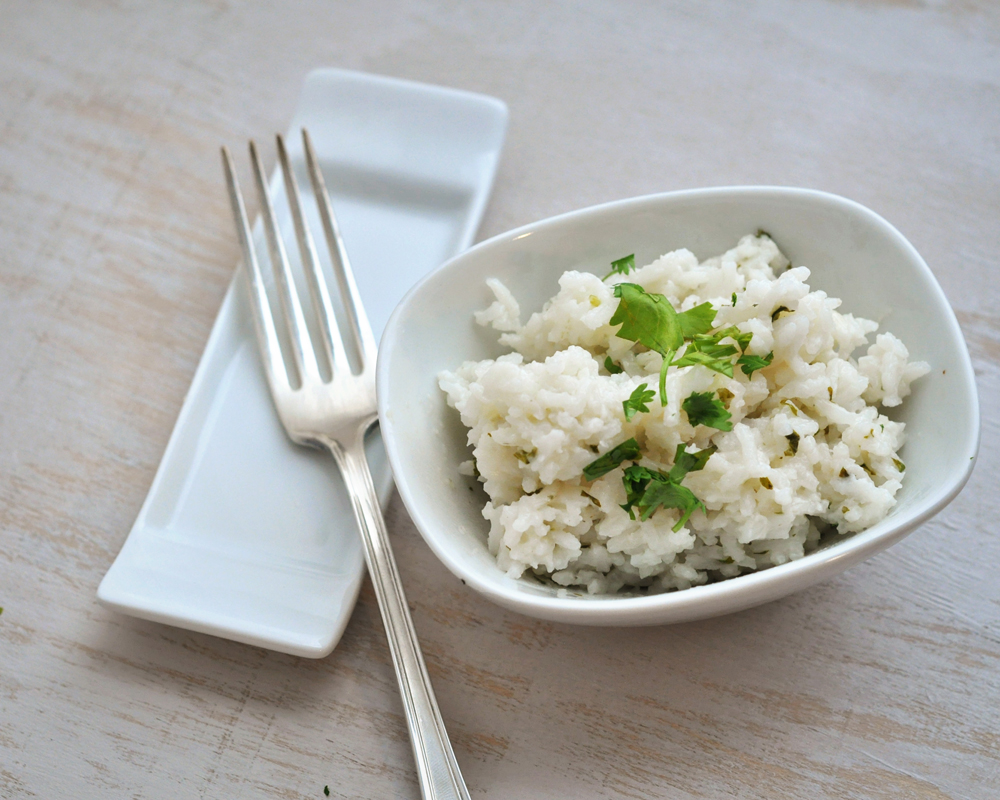
In the meantime, I continue to conduct the occasional experiment to see what kind of rice goodness I can create in my kitchen.  The latest equation involved jasmine rice and coconut milk.  I wouldn’t exactly say this produced outstanding rice.  If the scale I’m using to evaluate the results is 1 (boil in bag mush) to 10 (Chipotle’s cilantro lime rice….my absolute favorite), Coconut Rice is a solid 3 or 4.  It’s easy enough to prepare but the rice tends to get thick and gummy.  Maybe if I had rinsed the rice before putting it in the water my grains wouldn’t have stuck together quite as much.  Or maybe something like basmati would have been a better choice to use instead of jasmine.

So as a side dish on my dinner table, Coconut Rice doesn’t really make the cut.  But with a few adjustments, I could see this being the base for a great Coconut Rice Pudding as dessert.

Coconut Rice

Adapted from A Year in a Vegetarian Kitchen

  • 1 tablespoon vegetable oil
  • 1 teaspoon kosher salt
  • 1 1/2 cup jasmine rice
  • 1 (14 ounces) can light coconut milk
  • 1 1/4 cup water
  • juice and zest of 1 lime
  • 2 tablespoons fresh cilantro, minced

Heat the oil in a large saucepan over medium heat.  Add the salt and rice and stir until the rice is completely coated with the oil.  Stir in the coconut milk and water.  Bring to a boil then cover and simmer for 15 to 20 minutes until the rice is tender.  Add the lime juice, taste for seasoning and add salt as necessary.

Serve garnished with minced cilantro.

{printable recipe}

Flashback Friday – Gobble, Gobble

Flashback Friday

The following originally appeared on 11/21/08 at Exit 51

Gobble, Gobble

Want to know a secret?  I don’t like turkey.  Oh, I love me some crispy roasted turkey skin.  But the rest of the bird?  Not so much.

I’m not sure when all this started.  I used to enjoy the big Thanksgiving dinners that my grandmother made.  But then when I got the choice of what to make, I would never choose turkey.  So I’m always on the lookout for a non-turkey recipe that will absolutely rock the Thanksgiving table.  This year, I’m inspired by Deb over at Smitten Kitchen.

I’ve been looking for a main dish to become our Thanksgiving tradition, and I think with a few tweaks her Mushroom and Barley Pie may just be it.  Add some onion, applewood smoked bacon (mmmmm, bacon), wilted spinach, and a few more herbs and spices, and this could be a contender.

We’re big into the roasted veg these days so oven roasted butternut squash will definitely be on the table.  And I think I might, just maybe, try and see if I can’t make a decent stuffing.  Nothing will ever come close to my grandmother’s so I need to just get over that and find something that can become “my” stuffing.

So if you’re in the neighborhood next Thursday, stop by and see how everything turned out.  Just make sure you get your turkey fix taken care of before you do.  Because we are officially a gobble, gobble free zone!

Flashback Friday – Barefoot Contessa In The House

Flashback Friday

The following originally appeared on 11/20/08 at Exit 51.

Barefoot Contessa In The House

Less than 24 hours after my awesome acquisition of the new Barefoot Contessa cookbook, the good folks at the Washington Post had it in my hands. You guys rock!

97814000543501

I haven’t looked inside beyond the autographed title page yet.  I am afraid that once I start turning pages, I won’t be able to stop until I get to the end.  So for the time being, I’ll have to satisfy myself with Ina’s new Mustard Roasted Fish recipe posted in yesterday’s Food Section of The Post and today’s feature on her in the Post’s Home Section.

Confidential to SFC: I did this during lunch, I swear!

Apricot Honey Butter

Have I possibly mentioned the Complete Book of Small Batch Preserving?  Of course I have.  It is responsible for the dozens of jars of jams and preserves that have taken up residence in our basement.

It is my go to source for recipes that can be made any time of year.  For instance, that lovely apricot honey butter you see above?  I made that in May with dried apricots.  And it was spectacular.  I can’t even imagine what it would be like with fresh apricots.  I also used some special Saw Palmetto honey that my dad shipped up from Florida.  If you can get your hands on some fancy pants honey, use it.  If not, what you get from the grocery store will do you just fine.

I hope to move into the chapters with pickles and relishes this summer.  Until then, I’ve still got a ton of jams and jellies tagged that I want to try.

Apricot Honey Butter

Adapted from the Complete Book of Small Batch Preserving

BAH Note:  To be honest, I used about 1/2 cup honey and then I added enough agave nectar to get me to 2/3 cup of liquid.  I was really pleased with the flavor but I’ve made it before with all honey and it is equally enjoyable.  Do not overboil the mixture once you add the honey.  My notes on this recipe remind me that this set rather firm in the fridge and overcooking it results in a rather thick apricot honey butter which might be a formidable match for your toast.

  • 2 cups dried apricots, roughly chopped
  • 2 tablespoons lemon zest
  • 2 cups water
  • 1/2 cup lemon juice
  • 1/4 cup crystallized ginger roughly chopped
  • 2/3 cups honey

Combine the dried apricots, lemon zest, crystallized ginger, water, and lemon juice in a dutch oven.  Bring to a boil over high heat, cover and reduce heat.  Simmer, stirring occasionally, for 30 to 35 minutes until the apricots are tender.

Transfer the apricot mixture to a food processor and process until smooth.  Return the mixture to the dutch oven, add the honey, and bring to a simmer over medium heat.

Ladle the jam into heated jars, leaving 1/4 inch head space, and process for 10 minutes.

Let the jars cool for 24 hours before checking the seal and storing the jars. Any jars that have not sealed should be refrigerated or immediately reprocessed using new lids.

{printable recipe}

Gingered Rhubarb Jam with Honey

Once I finally bought a pot large enough to boil more than seven quarts of water at a time, I wanted to jump into canning.  The problem was that in our teeny, tiny house, there’s not a lot of room to store the stuff we already have, let alone the stuff that I want to can.  I convinced The Mistah to clean off a shelf in the basement for the canning supplies to live on.  But I still don’t have a great place to store the jars that are filled and sealed.  I see a trip to IKEA in my future to add another shelf to our IVAR system for the exclusive use of jams, pickles, and chutneys.

Fortunately, I made no promise to The Mistah that canning would ever save us any money.  But when he asks why I need to go out and buy a new shelf, especially since we got rid of a bunch of them just a few years ago, I’m going to hand him a jar of jam without saying a word.  The jam speaks for itself folks.

Gingered Rhubarb Jam with Honey

Adapted from The Complete Book of Small Batch Preserving

BAH Note: This book has been my canning salvation.  The recipes are all geared towards small batch production which suits my style perfectly.  I thought the Gingered Rhubarb came out tasting more strongly of honey with a gingered undertone.  It was a great addition to my steel cut oats in the morning but could also be used with pork, chicken, or biscuits.  I use a 5.5 quart dutch oven to make my jams and wouldn’t recommend using a pot any smaller than that.  I was able to get seven 4-ounce jars out of this recipe which is as close to the 3 1/4 cup yield stated in the book as I could hope to get.

  • 1 tablespoon lemon juice
  • zest of 1 lemon
  • 2 cups fresh or frozen rhubarb, chopped
  • 1 large Granny Smith apple, peeled, cored, and finely diced
  • 1/2 cup water
  • 1 1/2 cups granulated sugar
  • 1 cup honey
  • 1 1/2 tablespoons crystallized ginger, finely diced

Place the rhubarb, apple, water, and lemon zest into a large stainless steel pot or enamel dutch oven over high heat and bring to a boil.  Cover, reduce heat, and simmer for 15 minutes or until the fruit is tender.

Add the sugar, honey, ginger, and lemon juice.  Raise the heat and boil uncovered, stirring frequently, until the mixture gels, about 8 to 10 minutes.

Ladle the jam into heated jars, leaving 1/4 inch head space, and process for 10 minutes.  Let the jars cool for 24 hours before checking the seal and storing the jars. Any jars that have not sealed should be refrigerated or immediately reprocessed using new lids.

 {printable recipe}

Mushroom Barley Soup

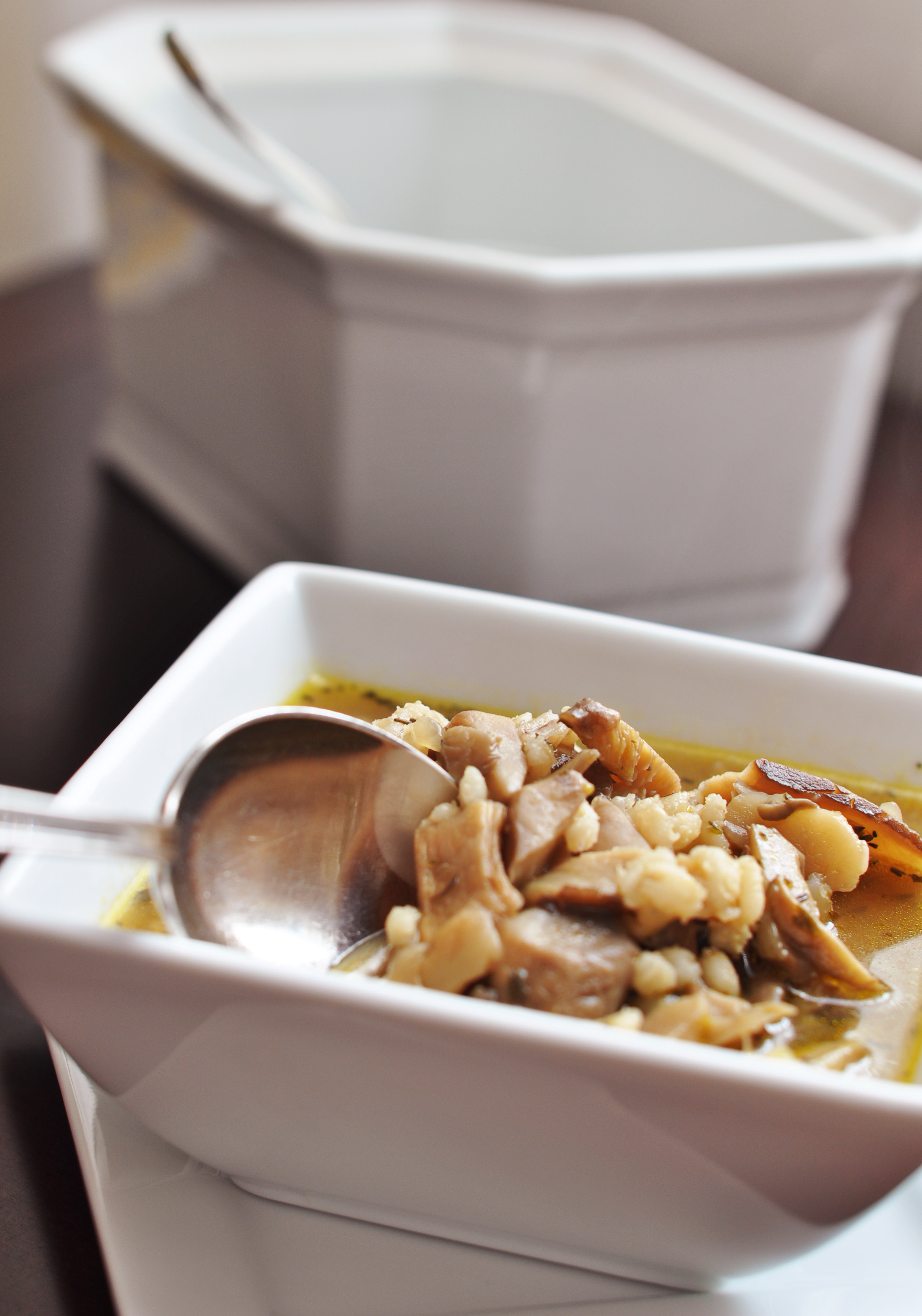
I’ve got mixed feelings about this soup.  I want to like it more than I did.  But the recipe I used called for way too much barley.  It was fine the first day, straight from the pot.  But as it sat in my refrigerator, the barley absorbed nearly all the liquid.  I also didn’t like the texture of the dried mushrooms I used.  And I swear they had an almost tobacco like flavor. Wow, when I think about it that way, I didn’t really like much about this soup at all.

The thing is that I have a Hearty Mushroom Soup that I know I like way better.  So why am I even bothering to tell you about this one?  Honestly, the only reason for this post is the fact that I really like the photo.

Note to self:  The next time you have a hankering for mushroom barley soup, take the recipe you know you like, cook up 1/4 cup of barley separately, and add it after the soup has cooked and been blitzed.  You’ll be much happier.

12 Hour Braised Onions

There are moments when the Universe throws a distinct pattern into my online adventures.  Take the day that I saw Barb at Vino Luci Style’s post about French Onion Soup. In the post she provided a Sur laTable recipe for slow braised onions.  Then over on Twitter, SmithBites was also talking about her love of the very same braised onions.  In my world, two things make for a pattern.  I know it’s not empirically sound, but it works for me.

So I heeded the Universe’s pattern, bought a boatload of onions, and got to braising.  As I type this, my onions are still doing their thing in the crockpot. It’s been almost 12 hours since I started them.  Clearly, while this is an easy recipe it’s far from quick.  But the beauty is that it makes enough braised onions to use for soups, sandwiches, salads, pizzas, or whatever you can imagine.

Actually, I raided the crockpot a few hours ago and pulled out a bunch of onions to add to the chicken casserole I was making for dinner.  After slicing up about a dozen onions, I had no desire to chop up another one.

***Update***

In the time that this post has been sitting in my ‘draft’ folder, I have started making braised onions on a regular basis.  Every other week or so I tie the crock pot up for day so that I can have a steady supply of these.  I have found that I use them interchangeably in recipes where onions are called for.  These onions go so quickly that they have evaded my camera lens.  The picture at the top of the post was some other recipe entirely, but it was the only photo of onions in my library.  Deb at SmithBites has some lovely pictures of them in her post.  So maybe you can mosey on over there and take a look.

Butter Braised Onions

Adapted from Sur la Table’s Gifts Cooks Love

BAH Note: Unless you’re a glutton for punishment, or have onion goggles, I recommend using a mandolin to slice the onions.  I give a range of how many onions to use.  Start with the least amount and see how much space you have left in your crockpot.  If you’ve got room for more, by all means add them.  I didn’t think about this and came very close to having more onions than my crockpot could accommodate.  Thankfully, the lid is somewhat domed so I was able to cram them all in.  In hindsight, perhaps that’s why it took mine over 12 hours to braise.

  • 8 to 12 onions –  sweet, red, or a combination, sliced about 1/4 inch thick
  • 1 stick butter
  • 2 tablespoons fresh thyme, minced
  • kosher salt

Slice the butter into tablespoons and place them on the bottom of your crockpot insert.  Add the onions and thyme.  Cover and cook on high for 2 hours.

After 2 hours, stir the onions.  Replace the cover and cook on high, without stirring, for another 6 to 8 hours until the onions are tender.  If you still have a lot of liquid in the crockpot, remove the lid and cook on high for an additional 1 to 2 hours or until most of the liquid has evaporated.  Turn the crockpot off and let the onions sit uncovered for 1 hour to cool.

Transfer to quart jars or plastic containers and store in the refrigerator.

{printble recipe}

Nigella’s Scallops with Pea Puree


Image by Ben Heine on deviantart.com

Most of the dishes I cook meet with The Mistah’s approval.  It is rare for him to provide negative feedback on a recipe.  But this one was a split decision.  I liked the slightly spiced pea puree.  The Mistah said something to the effect that the peas weren’t his favorite and that he prefers the other way that I make them.  What he specifically meant, I can’t be sure.  If you know, would you let me in on the secret?

Nigella’s Scallops with Pea Puree

Adapted from Nigella Kitchen

BAH Note: Try and get “dry” scallops, meaning they haven’t been injected with liquid.  Mine were “wet” (injected) and even though I tried a Cook’s Illustrated technique to dry them out a bit, my scallops didn’t get that lovely browned exterior because the liquid wept out into my pan causing them to steam more than to saute.

  • 1 pound frozen peas
  • 1 tablespoon mild curry paste
  • 1/3 cup sour cream or creme fraiche
  • 1 teaspoon kosher salt
  • 1 tablespoon olive oil
  • 1 tablespoon butter
  • 1 pound sea scallops
  • juice of 1 lime
  • juice of 1 lemon

Cook the peas in a saucepan, drain, and transfer to the food processor.  Add the curry paste, sour cream or creme fraiche, lime juice, and salt and process until smooth.  If the puree is on the thick side, drizzle in a teaspoon or two of olive oil. Cover the puree until ready to serve.

Pat the scallops dry and season with salt and pepper.  Melt the butter and olive oil in a large frying pan over medium high heat.  Working in batches if necessary, cook the scallops for two to three minutes per side until browned.

Transfer the scallops to a plate and deglaze the pan with the lemon juice.

Serve the scallops drizzled with pan sauce on a bed of pea puree.

{printable recipe}